

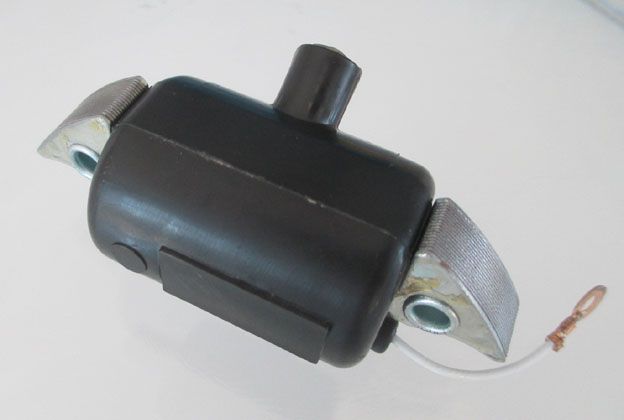


E59
OEM 364.4.50.512.2
NOTE
Always use a piston stop when clamping is held against.
If not, there is a risk of shifting the engagement with the flywheel shaft.
Look for proper frame connection that connects to the engine, not the frame.
Fitting a flywheel can be a challenge when faced with a combination of unfortunate circumstances.
Because a lot of unoriginal things have been done over time.
Therefore, therefore, variation occurs in certain measurements. (see below).
Therefore, even the most experienced can install a flywheel incorrectly.
1. THE NOTE
that guides the flywheel in the right place may be too low, or the groove in the crankshaft may be too deep. The result can therefore in certain cases be that the note does not stick up very much. It can be very unfortunate when clamping.
2. WIN
in nut or crankshaft may be more or less defective.
You sometimes see that the flywheel shaft has been hit, - with the result that the nut turns very tightly.
The tighter the nut goes, the more resistance must be held when tightening.
It can be a problem when at the same time counter is not held correctly.
3 CLAMPING
If, when tightening the flywheel, you hold back by blocking the flywheel's rotation, then the flywheel groove (split) will ultimately have to be able to withstand the extra torque caused by bad threads in the flywheel shaft. If the groove does not stick out very much, the result can easily be that the crankshaft cannot be held by the groove, and starts to turn. Quite simply because the contact point of the groove between the flywheel and the crankshaft is very weak.
4. SOLUTION
Search for freshened threads in the flywheel shaft, if it is needed and buy a new nut.
If the groove sits too deep, use a piston stop when mounting instead
Use a higher groove if it sits too deep. Possibly adapt to the old one.
5. ADJUSTMENT
On an E-ignition, you can only adjust the ignition timing on the base plate.
On an extremely rare occasion this is not sufficient.
The reason is that a large number of different cranks have been produced over time - not all of them have the perfect keyway position.
To compensate for this (provide greater adjustment margin) you can mount the flywheel without a groove.
Just taper on flywheel and flywheel shaft fit together well, (which they usually do), - this is not a problem.
In comparison, the old Zweirad engines did not use a groove or spline.
Use an ignition gun to be sure ignition timing is correct.
6. TOO LATE IGNITION
Combustion starts so late that the gas only ignites when it is on its way out through the exhaust.
That is why the engine "shoots in the exhaust" - it is the residual combustion that you can hear.
7. TOO EARLY IGNITION
Combustion starts so early that the gas is completely burned while the piston is still on its way up.
Too much preignition can cause engines to run the wrong way, or (more or less) try to prevent engines from running the right way around.
The combustion will therefore in these cases (more or less) work against the normal operation and direction of rotation of the engine, - and therefore very violent engine operation and a metallic sound can be heard.
8. CAUSE
The most likely cause is that the groove does not stick up sufficiently, - and that the flywheel shaft therefore goes free of engagement (between shaft and flywheel) whereby the shaft, when clamped, moves in the same direction as the clamping direction (clockwise).
On engines that turn "clockwise" (e.g. Maxi P and K), a very small displacement of the flywheel shaft (clockwise) will mean that the flywheel comes too late, and thus also that the ignition comes too late for the optimal ignition time. - Combustion therefore cannot be completed in the cylinder and therefore continues out through the exhaust, as a "poof" in the exhaust.
Exactly the same type of incorrect installation will (of course) have the exact opposite effect on engines with counter-clockwise rotation, - i.e. too early ignition, - and therefore you typically see that incorrect installation of flywheels on these (multiple gears) engines results in very rough engine running, which whether the engine tries to want to go the opposite way, and in some extreme cases actually does. Too strong or weak magnetism in flywheels used on electronic ignitions can also shift the ignition timing.
9. SOLUTION
Remember that neither the groove, crankshaft nor flywheel are made in the same factory.
Very small deviations in engagement (groove axis and flywheel) are the reason why engagement is often not as strong as in the old days. Therefore, it is not recommended to hold the counter in the flywheel when tightening the flywheel nut.
It is strongly recommended that piston stops are used when clamping, regardless of how experienced and skilled you may think you are. Piston stop is a simple tool that "locks" the piston so that the fastening of the flywheel cannot go wrong. Such a tool costs just DKK 45. Also always use a lighter to check your work. It can usually help to correct all types of errors.


